
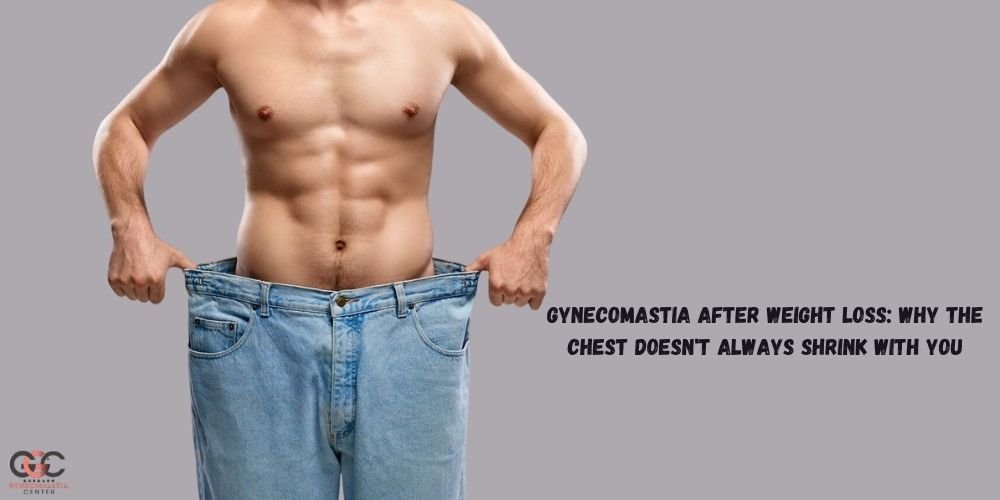
Losing weight is a major achievement. Whether you’ve transformed your lifestyle through diet and exercise or undergone bariatric surgery, you expect every part of your body to become leaner, including your chest.
However, many men are surprised to find that their chest still looks enlarged even after losing a significant amount of weight.
This can be frustrating. You’ve worked hard, your waistline has reduced, your clothes fit better, but the chest still appears puffy or rounded.
If this sounds familiar, you may not be dealing with stubborn fat alone. Persistent gynecomastia after weight loss is a common reason why the chest doesn’t always shrink along with the rest of the body.
In this article, Dr. Anmol Chugh explains why this happens, how to identify the cause, and when medical treatment may be the right solution.
Quick Answer
Weight loss reduces fat throughout the body, but it does not remove enlarged breast gland tissue.
If your enlarged chest is caused mainly by fat, it may improve as you lose weight.
If it is caused by gynecomastia (excess glandular tissue), the chest may continue to appear enlarged even after reaching a healthy weight.
The best treatment depends on whether the remaining fullness is due to fat, gland tissue, loose skin, or a combination of these.
Table of Contents
- Why Doesn’t the Chest Always Shrink After Weight Loss?
- Chest Fat vs Persistent Gynecomastia
- Why Does Gynecomastia Develop?
- Signs That You May Have Persistent Gynecomastia
- What About Loose Skin After Major Weight Loss?
- Can Exercise Remove Gynecomastia?
- When Should You Consider Treatment?
- How Is Persistent Gynecomastia Treated?
- Dr. Anmol Chugh’s Clinical Perspective
- Common Mistakes After Weight Loss
- Frequently Asked Questions
- Final Thoughts
Why Doesn’t the Chest Always Shrink After Weight Loss?
Many people assume that all chest enlargement is caused by excess body fat.
In reality, the male chest can contain:
- Fat tissue
- Breast gland tissue
- Loose skin
- A combination of all three
When you lose weight, fat cells become smaller. However, glandular tissue does not shrink in the same way.
This is why some men notice that their abdomen, arms, and face become slimmer, while their chest changes very little.
In patients who have lost a large amount of weight, loose skin can also contribute to the appearance of a fuller chest.
Chest Fat vs Persistent Gynecomastia
Understanding the difference is important because the treatment is different.
| Chest Fat (Pseudogynecomastia) | Gynecomastia |
| Caused mainly by excess fat | Caused by enlarged breast gland tissue |
| Usually improves with weight loss | Often remains despite weight loss |
| Soft to touch | Firm or rubbery beneath the nipple |
| More common in obesity | Can occur in men of any weight |
| Responds to diet and exercise | Usually requires surgery if persistent |
Some men have a combination of both conditions.
A clinical examination is often the best way to determine the underlying cause.
Why Does Gynecomastia Develop?
Gynecomastia occurs when there is an imbalance between the hormones oestrogen and testosterone, leading to the growth of breast gland tissue.
Several factors can contribute to this, including:
- Puberty
- Hormonal changes
- Certain medications
- Anabolic steroid use
- Medical conditions affecting hormone levels
- Genetics
Once glandular tissue develops, it often remains even after body fat decreases.
Signs That You May Have Persistent Gynecomastia
After losing weight, ask yourself these questions:
- Does the chest still appear enlarged despite reaching your target weight?
- Is there a firm lump beneath the nipple?
- Do the nipples remain puffy?
- Does your chest look different from the rest of your lean body?
- Have months of exercise failed to improve the chest shape?
If you answered “yes” to several of these questions, persistent gynecomastia may be the reason.
A consultation with an experienced plastic surgeon can help confirm the diagnosis.
What About Loose Skin After Major Weight Loss?
Men who lose a significant amount of weight, especially after bariatric surgery, may also develop loose chest skin.
In these cases, the enlarged appearance may not be caused by gland tissue alone.
The chest may have:
- Remaining fat
- Enlarged gland tissue
- Excess loose skin
Each of these requires a different surgical approach.
Some patients benefit from liposuction combined with gland removal, while others may also need skin tightening or skin excision to achieve a flatter chest.
Can Exercise Remove Gynecomastia?
Exercise is excellent for improving overall health and reducing body fat.
However, it cannot remove enlarged breast gland tissue.
Strength training can build the chest muscles underneath, but it does not eliminate the gland itself.
This is why some men develop well-defined shoulders and arms while their chest continues to appear enlarged.
Maintaining a healthy lifestyle is still important because it supports overall fitness and helps preserve surgical results if treatment is required.
When Should You Consider Treatment?
You may benefit from an evaluation if:
- Your weight has remained stable for several months.
- Your chest still appears enlarged.
- Exercise has not improved the chest contour.
- You feel uncomfortable wearing fitted clothing.
- Your confidence is affected by the appearance of your chest.
A proper diagnosis helps determine whether surgery is appropriate or whether another treatment option may be more suitable.
How Is Persistent Gynecomastia Treated?
The right treatment depends on what is causing the enlarged chest after weight loss.
If Excess Fat Is the Main Problem
When the enlargement is mostly due to fat (pseudogynecomastia), lifestyle changes and maintaining a healthy weight may continue to improve the chest appearance. In selected cases, liposuction may be considered to improve body contour.
If Gland Tissue Is Present
When enlarged breast gland tissue remains after weight loss, surgery is usually the most effective treatment.
Gynecomastia surgery may involve:
- Liposuction to remove excess fat.
- Surgical removal of the glandular tissue.
- Chest contouring to create a flatter, more masculine appearance.
The exact technique depends on your chest anatomy and the severity of the condition.
If There Is Loose Skin
Men who have lost a large amount of weight may also have excess skin that does not tighten on its own.
In these cases, your surgeon may recommend combining gland removal or liposuction with skin tightening or skin excision to achieve the best contour.
A personalised treatment plan is important because no two patients have exactly the same combination of fat, gland tissue, and loose skin.
Dr. Anmol Chugh’s Clinical Perspective
Many patients come to me after an incredible weight-loss journey feeling disappointed that their chest hasn’t changed as much as the rest of their body. They often believe they haven’t exercised enough or that they simply need to lose more weight.
In many of these cases, the problem isn’t a lack of effort, it’s the presence of persistent glandular tissue or loose skin, which cannot be corrected through diet or exercise alone.
During consultation, I carefully examine whether the remaining fullness is due to fat, gland tissue, loose skin, or a combination of these factors. This helps us choose the most appropriate treatment and set realistic expectations. The goal is not just to remove tissue but to create a balanced, natural-looking chest that complements the patient’s new physique.
Common Mistakes After Weight Loss
Trying to Lose Even More Weight
Some men continue dieting aggressively, hoping their chest will eventually become flatter.
If gland tissue is the cause, additional weight loss is unlikely to make a significant difference and may even lead to more loose skin.
Thinking Chest Exercises Will Remove Gland Tissue
Push-ups, bench presses, and weight training strengthen the chest muscles but do not remove enlarged breast glands.
Exercise remains important for overall fitness, but it cannot replace appropriate medical treatment when gland tissue is present.
Ignoring Loose Skin
After major weight loss, excess skin can continue to make the chest appear enlarged even when most of the fat has been lost.
An experienced plastic surgeon can determine whether skin tightening or skin removal is necessary.
Frequently Asked Questions
Will gynecomastia disappear after losing weight?
If the enlargement is caused mainly by excess fat, it may improve with weight loss. However, enlarged breast gland tissue usually remains and may require surgery if it continues to affect the chest contour.
How long should I wait after weight loss before considering surgery?
Most surgeons recommend waiting until your weight has been stable for several months. This helps ensure long-lasting results and allows your body to adjust after weight loss.
Can gynecomastia come back after surgery?
In most cases, the removed glandular tissue does not return. However, significant weight gain, anabolic steroid use, certain medications, or hormonal imbalances may contribute to future chest enlargement in some individuals.
Will there be visible scars after surgery?
Modern gynecomastia surgery is planned to keep scars as discreet as possible. The exact location and size of the incision depend on the surgical technique and the amount of tissue that needs to be removed.
Final Thoughts
Reaching your weight-loss goal is a major achievement, but it can be discouraging if your chest doesn’t reflect the rest of your transformation.
The reason is often simple: weight loss reduces fat, but it does not always eliminate enlarged breast gland tissue or excess skin. Understanding the difference is the first step toward finding the right solution.
If your chest remains enlarged despite maintaining a healthy weight, a professional evaluation can help identify the underlying cause and determine the most appropriate treatment. With the right approach, it is often possible to achieve a flatter, more proportionate chest that matches the rest of your body.
References
- Braunstein GD. Gynecomastia. N Engl J Med. 2007;357(12):1229–1237.
- Johnson RE, Murad MH. Gynecomastia: Pathophysiology, evaluation, and management. Mayo Clin Proc. 2009;84(11):1010–1015.
- American Society of Plastic Surgeons. Male Breast Reduction (Gynecomastia Surgery). Available from: https://www.plasticsurgery.org
- StatPearls Publishing. Gynecomastia. Treasure Island (FL): StatPearls Publishing; Updated 2025.
- International Society of Aesthetic Plastic Surgery (ISAPS). Patient Safety Resources for Male Breast Reduction. Available from: https://www.isaps.org
Take the Next Step
If you’ve lost weight but still feel self-conscious about the appearance of your chest, a consultation with Dr. Anmol Chugh can help identify the cause. After a detailed examination, he will determine whether the remaining fullness is due to fat, glandular tissue, loose skin, or a combination of these factors, and recommend a personalised treatment plan designed to achieve a flatter, natural-looking chest with long-lasting results.