
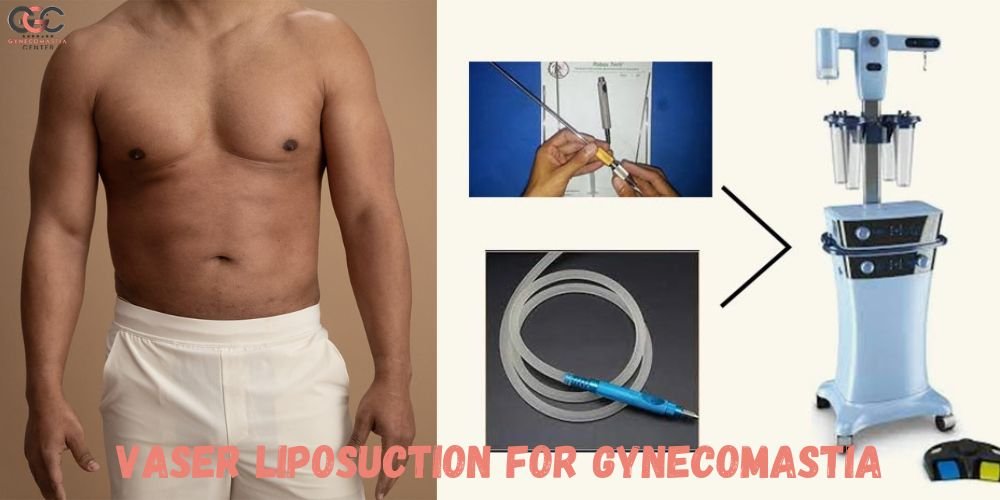
Gynecomastia is a common condition that causes enlargement of the male chest. For some men, it develops during puberty and goes away naturally. For others, it persists into adulthood and can affect confidence, clothing choices, and everyday activities.
If you’ve been researching treatment options, you’ve probably come across VASER liposuction for gynecomastia. It is often promoted as an advanced technique for chest contouring, but many patients wonder how it actually works and whether it is suitable for every case.
The answer is not always straightforward.
While VASER technology can play an important role in gynecomastia surgery, it is not the complete treatment for every patient. The best approach depends on whether your enlarged chest is caused by fat, glandular tissue, loose skin, or a combination of these.
In this article, Dr. Anmol Chugh explains how VASER liposuction works, its benefits, its limitations, and who may be a suitable candidate.
Table of Contents
- Quick Answer
- What Is VASER Liposuction?
- How Does VASER Liposuction Work?
- Can VASER Treat Every Gynecomastia Patient?
- Who Is a Good Candidate for VASER Liposuction?
- Benefits of VASER Liposuction for Gynecomastia
- What VASER Liposuction Cannot Do
- What Is the Recovery Like?
- Dr. Anmol Chugh’s Clinical Perspective
- Common Misconceptions About VASER Liposuction
- Frequently Asked Questions
- Final Thoughts
- References
- Related Articles
Quick Answer
VASER liposuction for gynecomastia uses ultrasound energy to break down fat before it is removed from the chest.
It can be an effective option for removing excess fat and improving chest contour. However, VASER does not remove enlarged breast gland tissue. Many patients with gynecomastia require both VASER liposuction and surgical gland removal to achieve a flatter, more natural-looking chest.
A proper examination by an experienced plastic surgeon is the best way to determine the right treatment plan.
What Is VASER Liposuction?
VASER stands for Vibration Amplification of Sound Energy at Resonance.
It is a type of ultrasound-assisted liposuction that uses specialised sound waves to loosen fat cells before they are gently removed.
Unlike traditional liposuction, where fat is removed directly through suction, VASER first helps separate fat from surrounding tissues. This may allow for more controlled fat removal in selected patients.
Today, VASER technology is used for various body contouring procedures, including:
- Abdomen
- Waist and flanks
- Arms
- Thighs
- Back
- Chin
- Male chest contouring
For men with gynecomastia, VASER is often combined with other surgical techniques to improve chest shape.
How Does VASER Liposuction Work?
The procedure generally involves several steps.
Step 1: Small Incisions
Tiny incisions are made in discreet areas of the chest.
These openings allow the surgeon to introduce the VASER probe and later remove the loosened fat.
Step 2: Ultrasound Energy
The VASER probe delivers controlled ultrasound energy into the fatty tissue.
This energy helps loosen and emulsify fat cells while aiming to minimise disruption to surrounding structures.
Step 3: Fat Removal
Once the fat has been loosened, it is removed using a thin suction cannula.
The surgeon carefully sculpts the chest to create smoother, more balanced contours.
Step 4: Chest Contouring
The final goal is not simply fat removal but achieving a natural-looking chest that matches the patient’s body proportions.
The exact surgical plan depends on each patient’s anatomy and the cause of the chest enlargement.
Can VASER Treat Every Gynecomastia Patient?
This is one of the biggest misconceptions.
The answer is no.
Many online videos create the impression that VASER alone can solve every case of gynecomastia.
In reality, gynecomastia is not always caused by fat alone.
The enlarged chest may contain:
- Fat
- Breast gland tissue
- Loose skin
- A combination of all three
VASER is designed to assist with fat removal.
However, it cannot completely remove firm glandular breast tissue, which is one of the defining features of true gynecomastia.
If gland tissue remains, the chest may continue to appear puffy even after liposuction.
For this reason, many patients achieve the best results with:
- VASER liposuction for fat removal
- Surgical gland excision for persistent gland tissue
Combining these techniques often provides a flatter and more masculine chest contour.
Who Is a Good Candidate for VASER Liposuction?
A detailed consultation is essential to determine whether VASER is appropriate.
In general, suitable candidates may include men who:
- Have mild to moderate gynecomastia.
- Have excess chest fat along with gland tissue.
- Maintain a stable body weight.
- Have good skin elasticity.
- Are in good general health.
- Have realistic expectations about the results.
Every patient is different, so the treatment plan should always be personalised.
Benefits of VASER Liposuction for Gynecomastia
When used in appropriate patients, VASER technology offers several potential advantages.
Improved Chest Contouring
VASER helps the surgeon remove fat more precisely, which can contribute to smoother chest contours.
Small Incisions
The procedure is performed through small incisions that are usually placed in less noticeable areas.
Can Be Combined with Gland Removal
One of the greatest advantages is that VASER can easily be combined with gland excision when needed.
This allows the surgeon to address both excess fat and enlarged gland tissue during the same operation.
Suitable for Multiple Areas
Some patients choose to combine gynecomastia surgery with liposuction of nearby areas such as the flanks or abdomen, depending on their body contouring goals.
May Be Associated with Less Bruising in Selected Patients
Some studies suggest that ultrasound-assisted liposuction may be associated with reduced tissue trauma in appropriately selected patients. However, recovery varies from person to person and depends on several factors, including the extent of surgery and individual healing.
What VASER Liposuction Cannot Do
Understanding the limitations is just as important as understanding the benefits.
VASER is not designed to:
- Remove dense breast gland tissue by itself.
- Replace gland excision when gland tissue is present.
- Treat significant loose skin in every patient.
- Serve as a weight-loss procedure.
- Prevent future weight gain.
Technology is only one part of successful gynecomastia surgery. The surgeon’s experience, diagnosis, and treatment planning remain the most important factors in achieving natural-looking results.
What Is the Recovery Like?
Recovery after VASER liposuction for gynecomastia depends on the extent of the surgery and whether gland removal was also performed.
Most patients can expect the following general timeline:
First Few Days
- Mild swelling, bruising, and soreness are common.
- Pain is usually manageable with prescribed medication.
- Gentle walking is encouraged to improve circulation.
First Week
Many patients with desk-based jobs can return to work within 3–7 days, depending on their recovery and the nature of their work.
Compression Garment
A compression garment is usually recommended for several weeks to:
- Reduce swelling
- Support healing tissues
- Help the chest adapt to its new contour
Following your surgeon’s instructions on wearing the garment is an important part of recovery.
Exercise
Light walking is encouraged early, but strenuous exercise, heavy lifting, and chest workouts should only be resumed after your surgeon confirms it is safe to do so.
Final Results
Although an improvement in chest shape can often be seen early, swelling gradually settles over the following weeks. Final results continue to develop as healing progresses.
Dr. Anmol Chugh’s Clinical Perspective
One of the most common requests I hear is, “Doctor, I only want VASER liposuction.” This usually comes from patients who have seen online videos or advertisements highlighting the technology.
However, the most important step is not choosing the machine, it’s making the correct diagnosis. During consultation, I carefully assess whether the enlarged chest is caused by excess fat, glandular tissue, loose skin, or a combination of these factors.
If gland tissue is present, VASER alone is unlikely to produce the desired result. In many patients, combining VASER liposuction with gland excision creates a flatter, more natural-looking chest. My goal is always to recommend the procedure that best matches the patient’s anatomy rather than relying on a single technology for every case.
Common Misconceptions About VASER Liposuction
“VASER Alone Can Treat Every Case”
This is one of the biggest myths.
While VASER is highly effective for removing fat, it cannot completely remove enlarged glandular tissue, which is often responsible for true gynecomastia.
“It’s a Weight-Loss Procedure”
VASER liposuction is a body contouring procedure, not a treatment for obesity or weight loss.
It works best for men who are close to their ideal body weight but have persistent chest enlargement that has not improved with diet and exercise.
“Technology Is More Important Than the Surgeon”
Advanced technology is valuable, but it is only one part of successful treatment.
The surgeon’s ability to diagnose the condition correctly, choose the appropriate technique, and sculpt the chest naturally has a much greater impact on the final result.
Frequently Asked Questions
Is VASER liposuction better than traditional liposuction for gynecomastia?
VASER technology may allow more precise fat removal in selected patients. However, the best technique depends on your individual condition, and many patients also require gland removal to achieve optimal results.
Can VASER remove breast gland tissue?
No. VASER is designed to assist with fat removal. Firm glandular tissue usually requires surgical excision if it is contributing to chest enlargement.
Will there be visible scars?
Gynecomastia surgery is generally performed through small incisions placed in discreet locations. If gland removal is needed, an additional incision is often made along the edge of the areola to help keep scars as inconspicuous as possible.
Are the results permanent?
The fat cells and glandular tissue removed during surgery are generally gone permanently. Maintaining a stable weight and avoiding factors such as anabolic steroid use can help preserve the results over the long term.
Final Thoughts
VASER liposuction for gynecomastia is an advanced tool that can improve chest contour by helping remove excess fat with precision. However, it is not a standalone solution for every patient.
Many men with gynecomastia also have enlarged glandular tissue, which typically requires surgical removal to achieve a flat, masculine chest. The most successful outcomes come from choosing the right treatment plan based on your individual anatomy—not simply selecting a particular technology.
A detailed consultation with an experienced plastic surgeon can help determine whether VASER liposuction, gland excision, or a combination of both is the most appropriate approach for you.
References
- Rohrich RJ, Ha RY, Kenkel JM, Adams WP. Classification and management of gynecomastia: Defining the role of ultrasound-assisted liposuction. Plast Reconstr Surg. 2003;111(2):909–923.
- Braunstein GD. Gynecomastia. N Engl J Med. 2007;357(12):1229–1237.
- American Society of Plastic Surgeons. Male Breast Reduction (Gynecomastia Surgery). Available from: https://www.plasticsurgery.org
- International Society of Aesthetic Plastic Surgery (ISAPS). Patient Safety Resources. Available from: https://www.isaps.org
- StatPearls Publishing. Gynecomastia. Treasure Island (FL): StatPearls Publishing; Updated 2025.
Take the Next Step
If you’re considering VASER liposuction for gynecomastia, the first step is an expert evaluation to identify the true cause of your enlarged chest. Dr. Anmol Chugh will assess whether your condition is due to excess fat, glandular tissue, loose skin, or a combination of these factors, and recommend the most suitable treatment plan. With a personalised approach and advanced surgical techniques, the goal is to achieve a flatter, natural-looking chest while prioritising safety, long-term results, and patient satisfaction.